
By Dorris Keeven-Franke
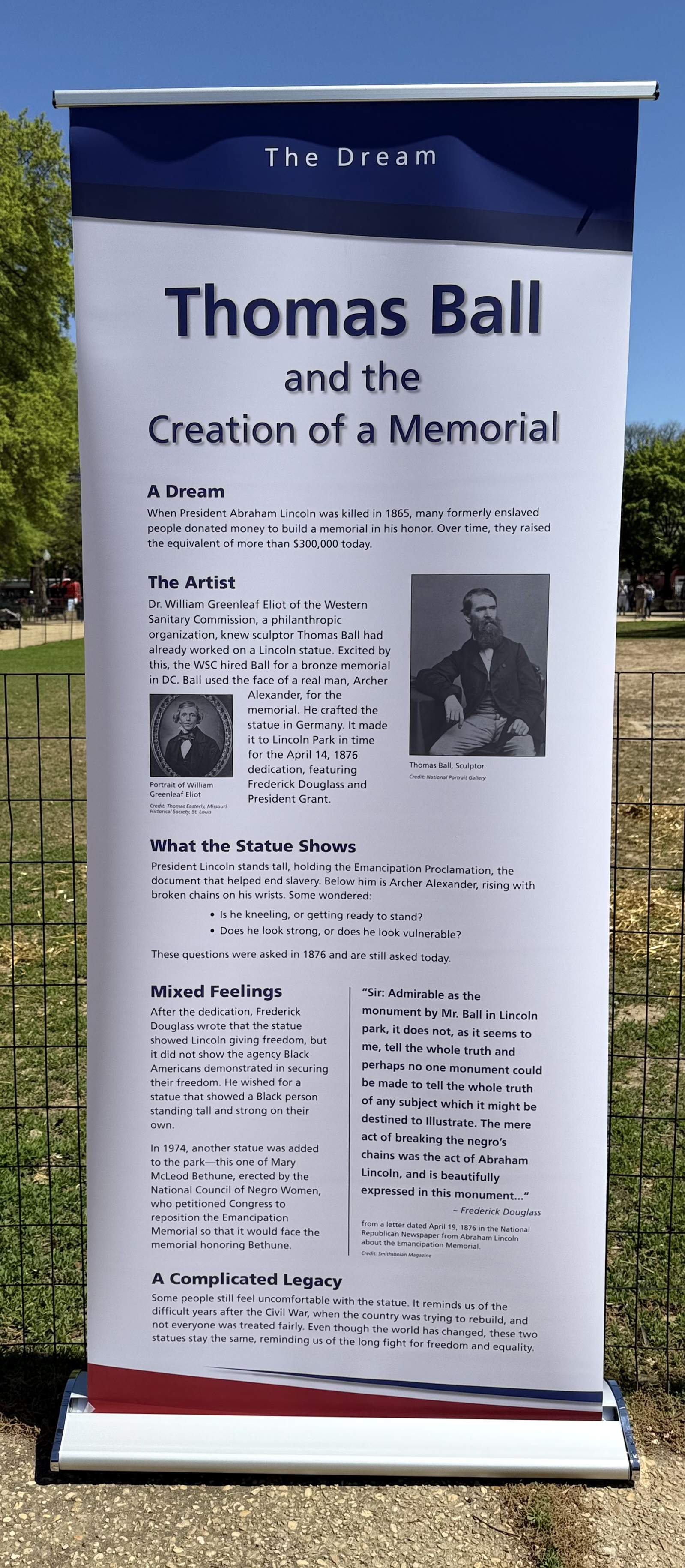
Direction can be a matter of perspective. When I was young, time seem to stretch out for an immeasurable distance. As I have grown older, that same distance seems to have become far shorter. There is a memorial to our 16th President, Abraham Lincoln, in Washington, DC’s Lincoln Park, which dates back over 150 years, and is often subjected to very different emotionally charged discussions these days based on our differing perspectives. It’s important to keep the monument’s full history intact, and look at it in the context of its’ time. It was 1865, and a time when our country was mourning the loss of a president who was both beloved and hated. The President that had kept our country intact, while ending slavery. The monument’s purpose was a memorial to our martyred President, and the second person on the monument is really only there to provide meaning and give context to the issue of slavery. However, it is the image of that real live enslaved man, whose name is Archer Alexander, who often draws the viewer’s attention. Some feel he is submissive and kneeling, while others see him as rising to his future role as a free man.
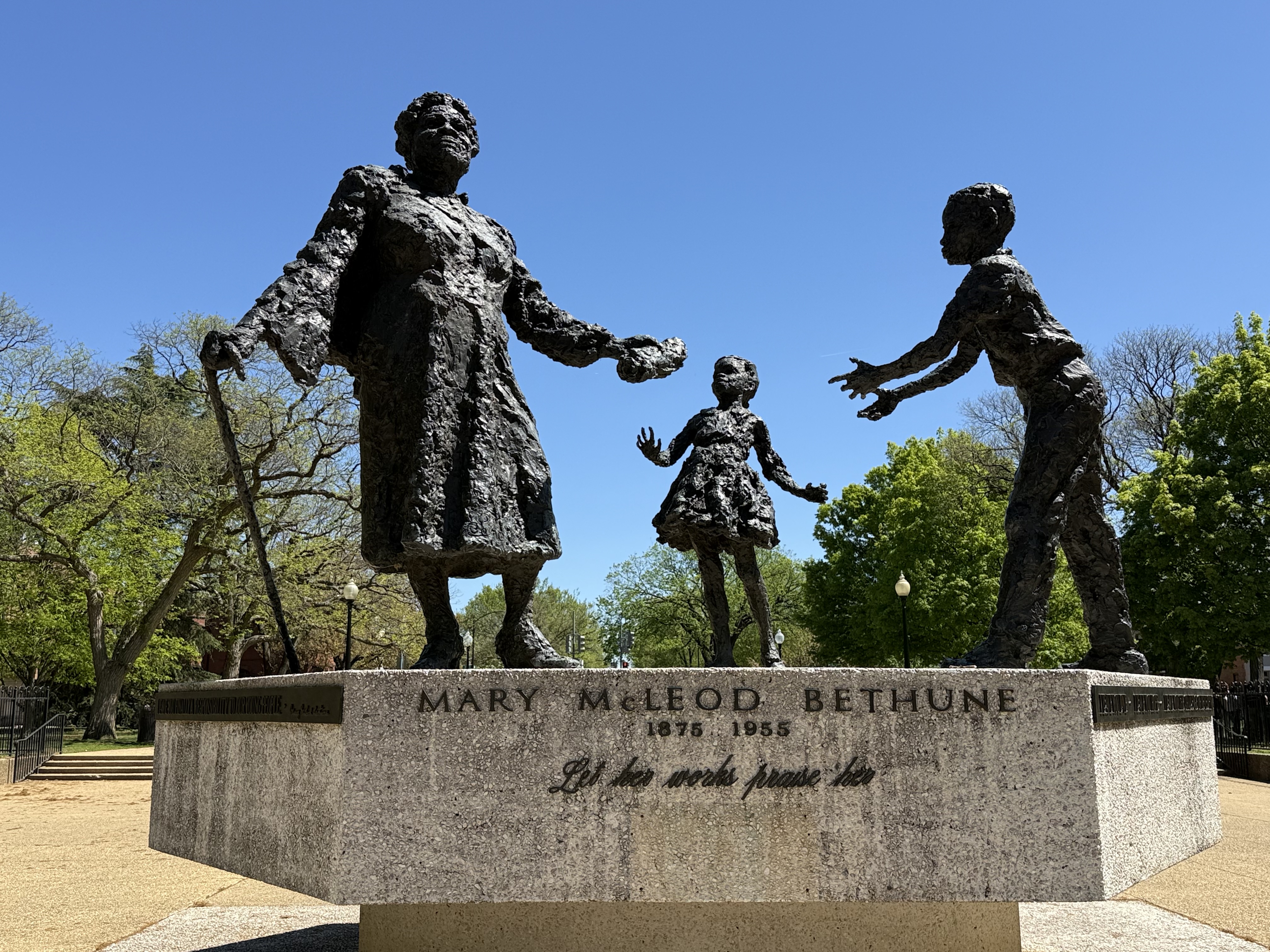
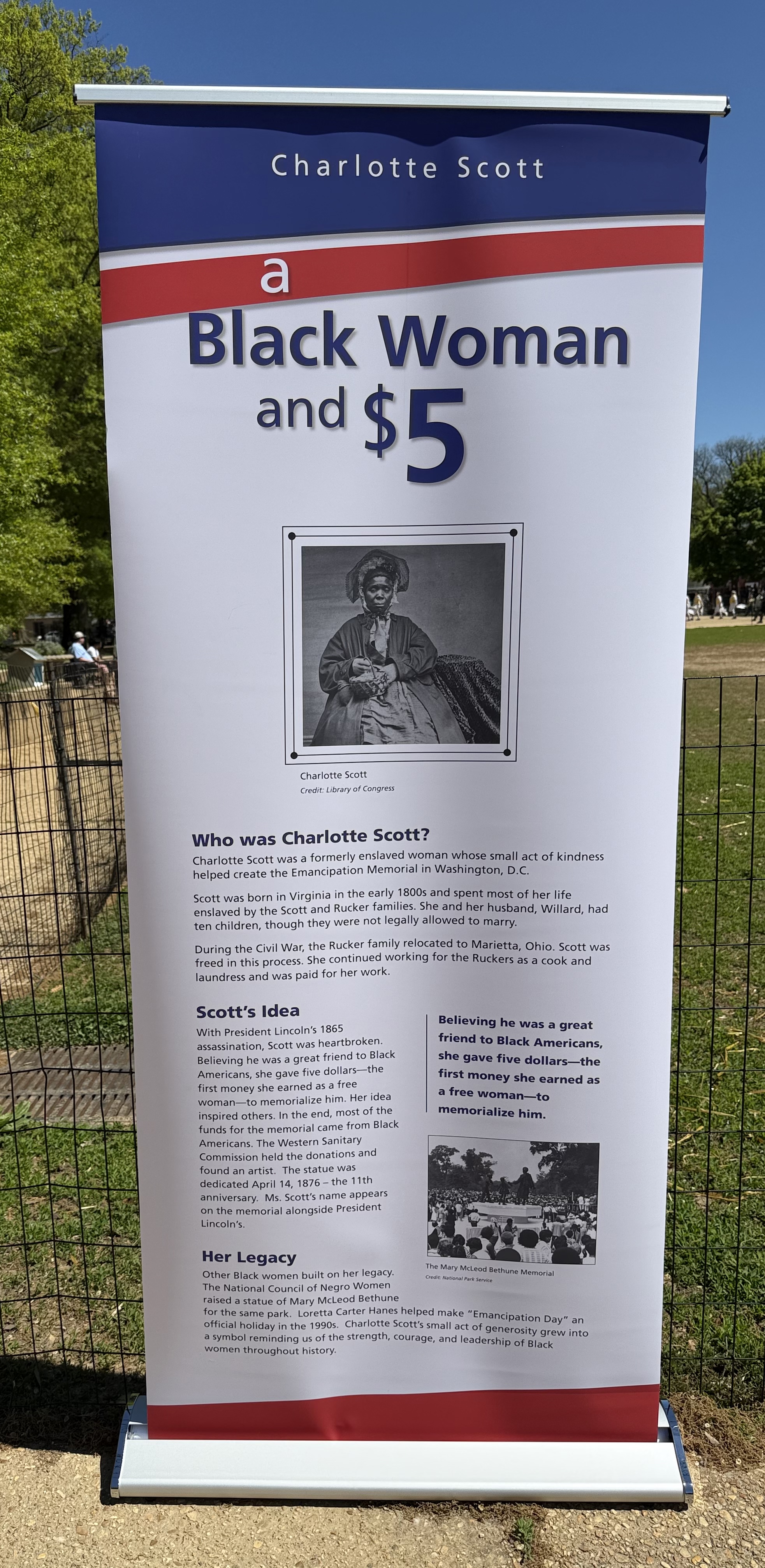
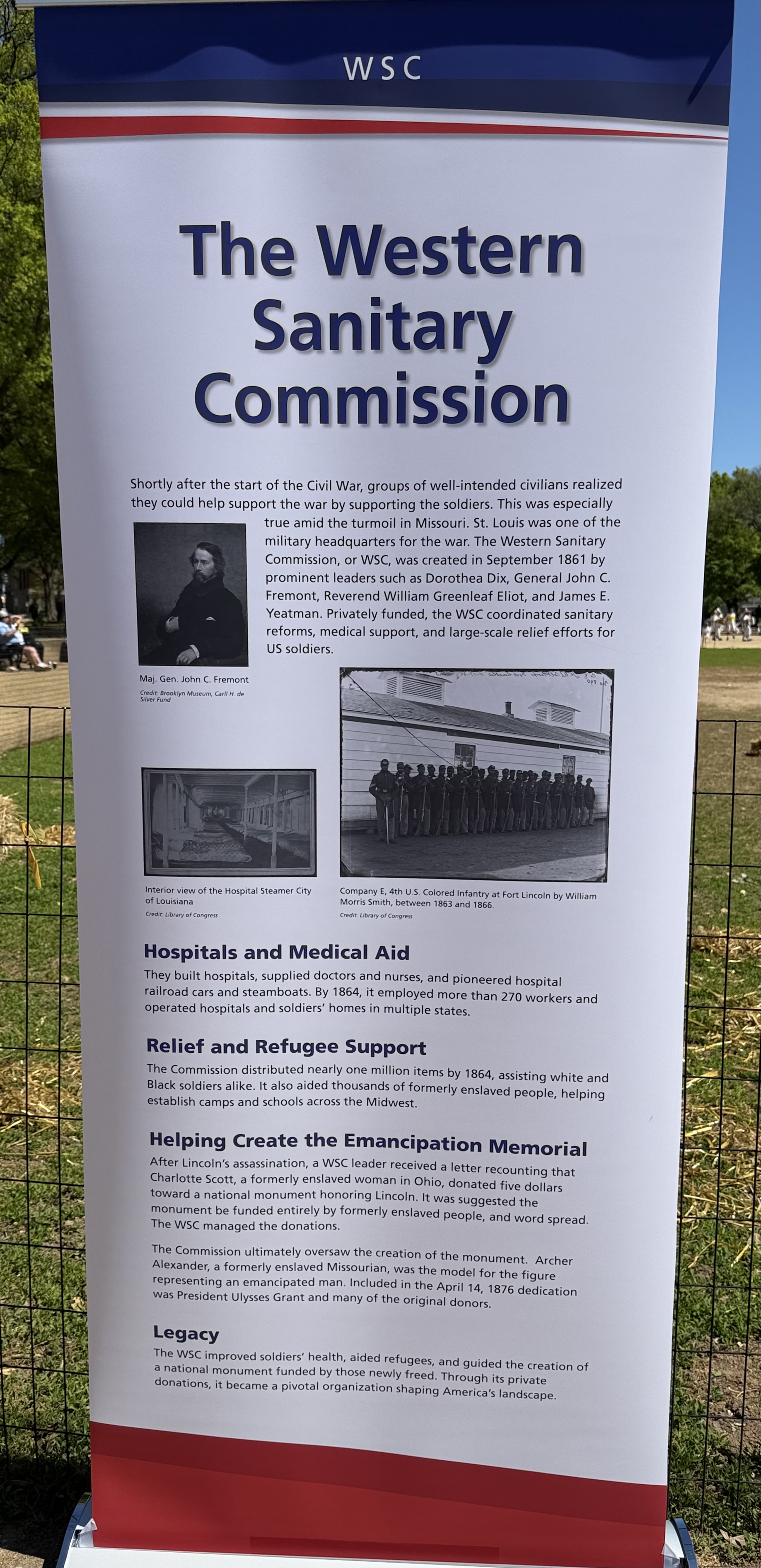
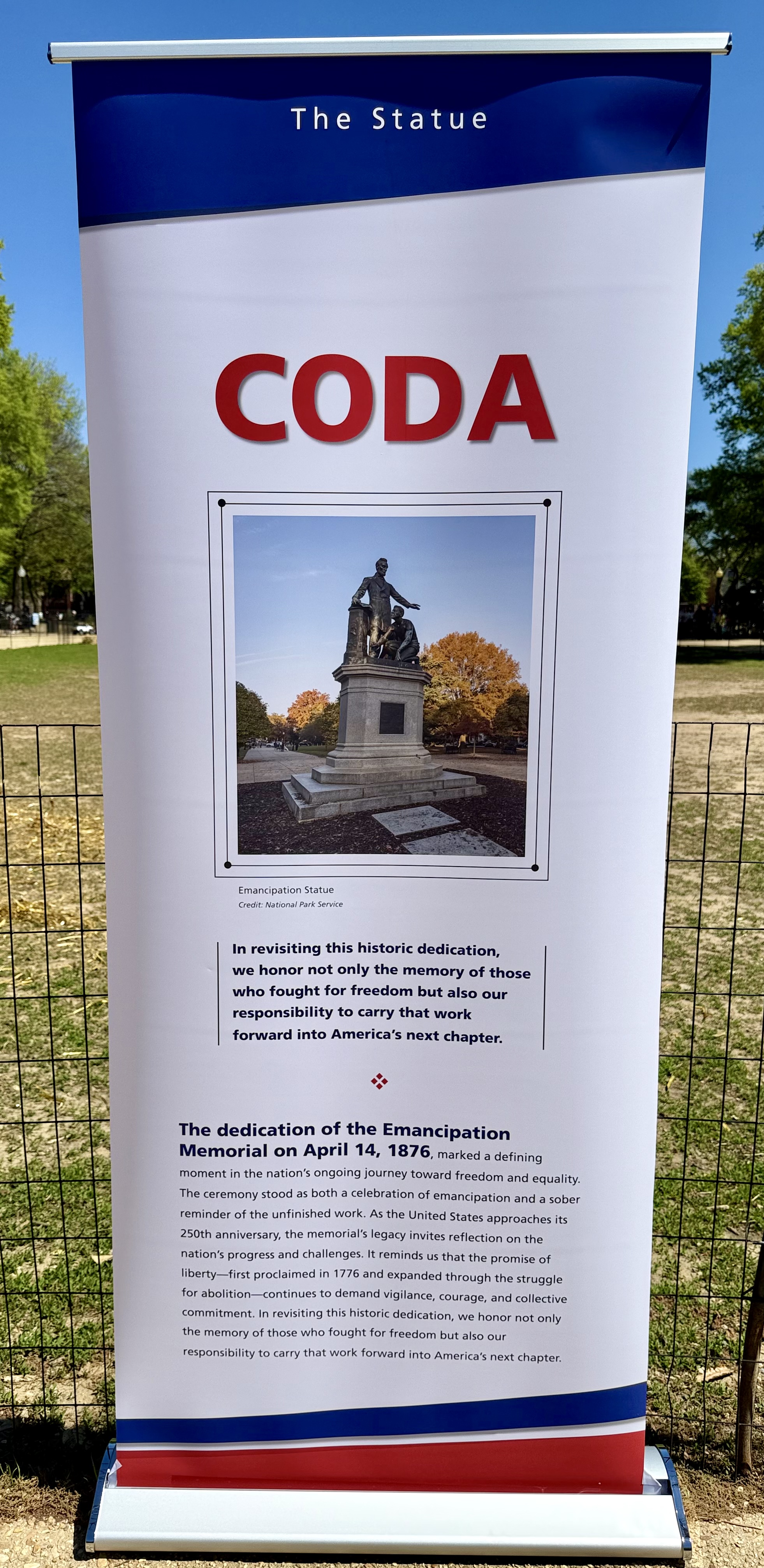
I will begin with the facts of its background. It has been referred to as the Freedom Memorial and the Freedmen’s Memorial. Because the only word written on it is the word Emancipation, it is most often referred to as the Emancipation Memorial. It is located in Lincoln Park, which was part of L’Enfant’s original design of Washington, D.C. Today, the park, which includes Mary McLeod Berthune Monument is under the care of our National Park Service and it is also listed on the National Register of Historic Places, which requires a Congressional order to alter its’ position. On April 14th, 1876, the 11th anniversary of Lincoln’s assassination, it was the first monument to be placed in the park and was a memorial to President Abraham Lincoln, who had been assassinated eleven years before its dedication. The brainchild of a woman named Charlotte Scott, it was entirely paid for by the formerly enslaved, the U.S. Colored Troops, and the freedmen of America, while the funds were held in trust by the Western Sanitary Commission. The WSC was located in St. Louis, Missouri, and was a private non-profit commission created by General Fremont at the beginning of the Civil War, and approved by Lincoln. They built hospitals and cared for the wounded of the Union Army in the Western Theater during the Civil War. The monument’s sculptor was a famous American-born artist from Boston named Thomas Ball, who had first conceived the sculpture at the time of Lincoln’s assassination in 1865. The sculpture depicts two men: President Lincoln and a real man, born enslaved, whose name is Archer Alexander. Alexander is the great-great-great-grandfather of Muhammad Ali.
THE UNVEILING CEREMONY
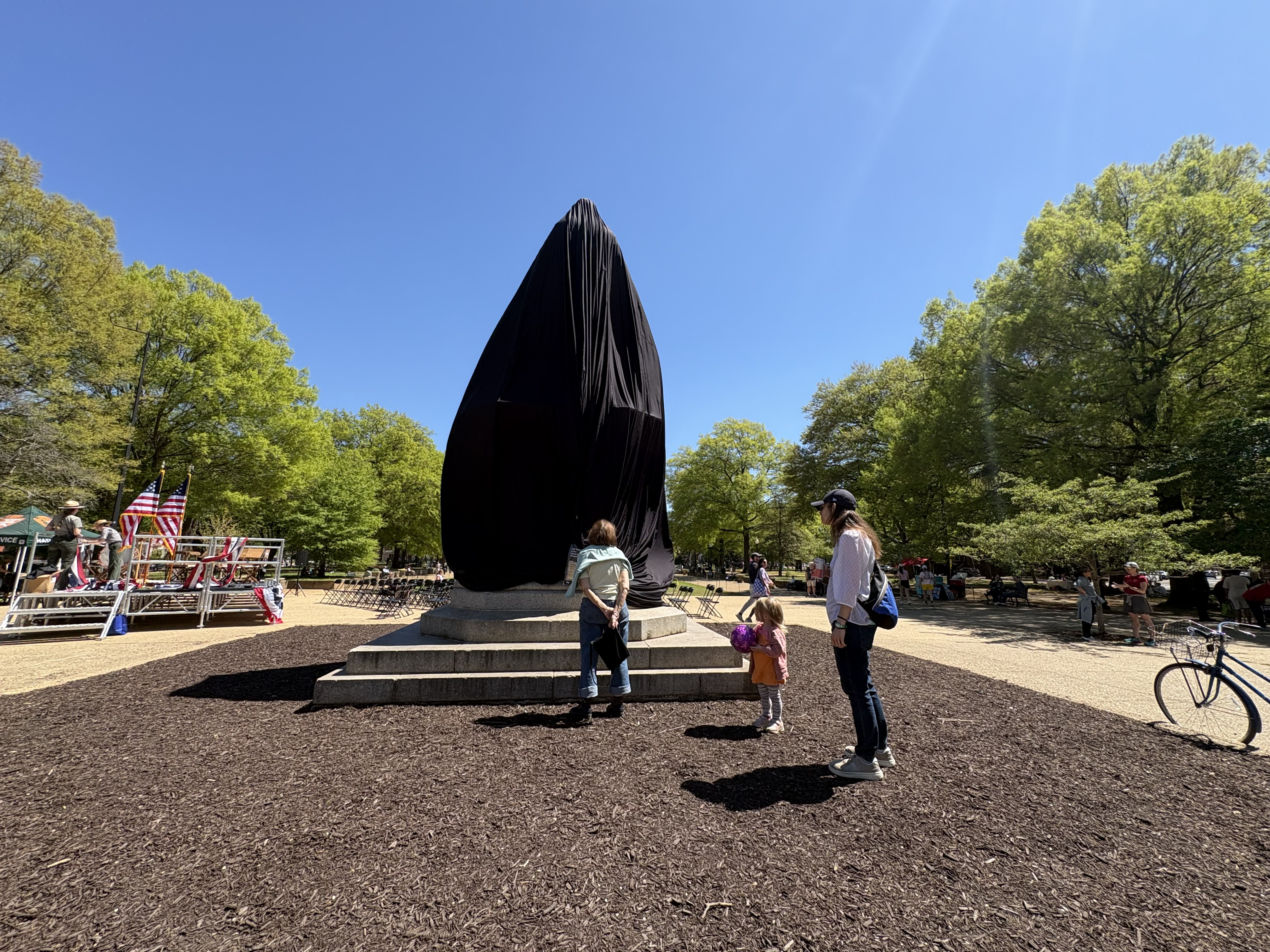
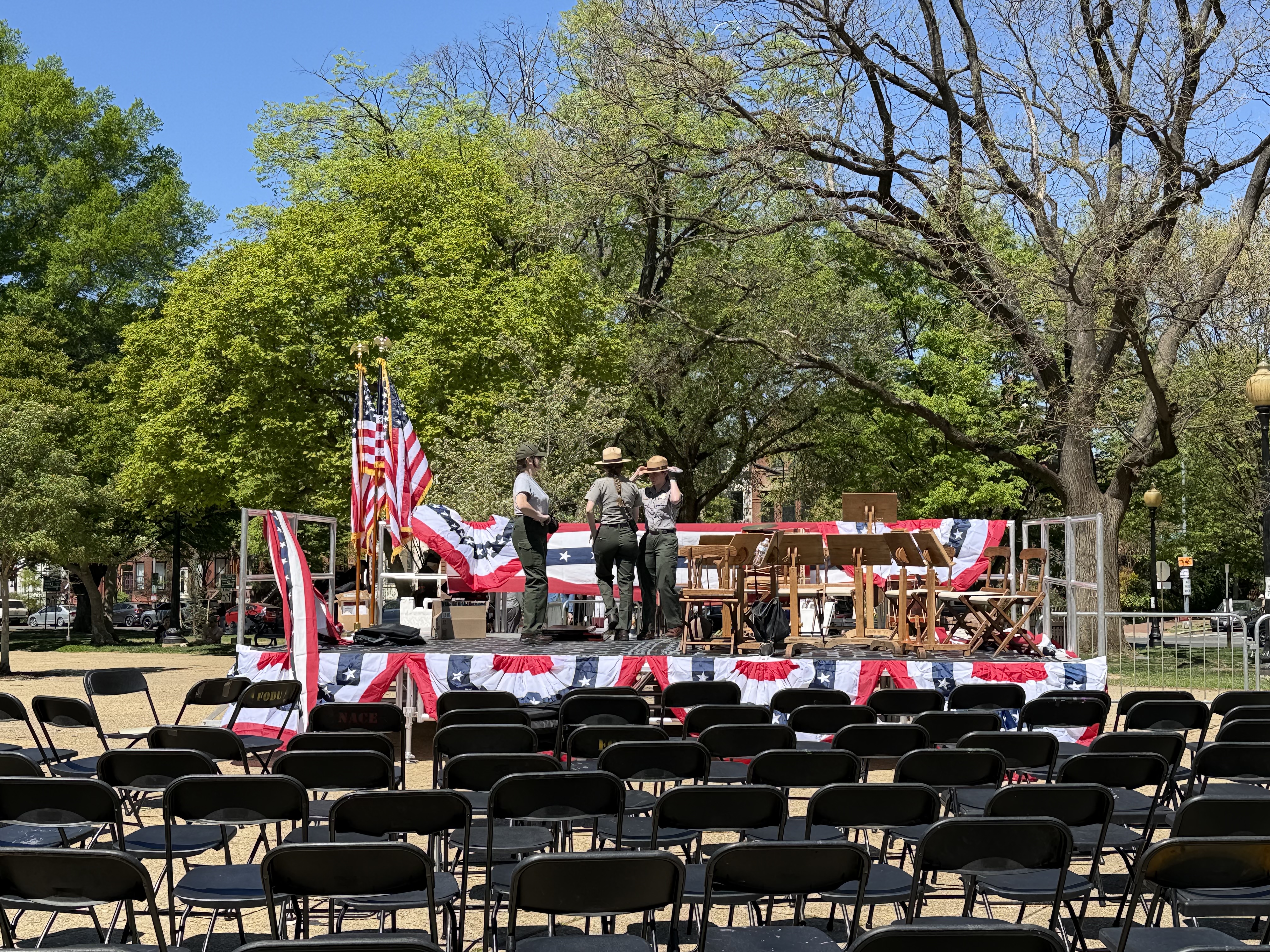
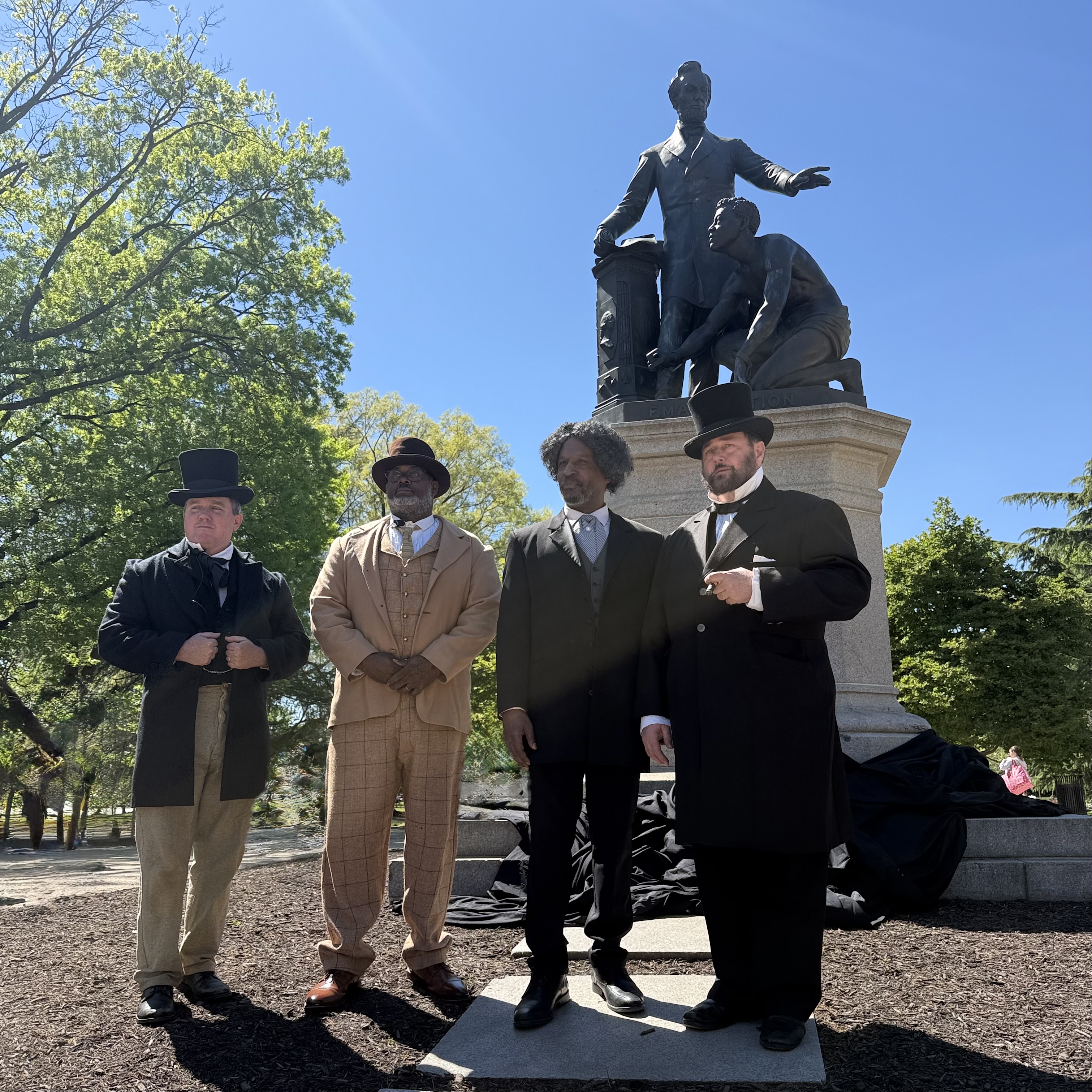
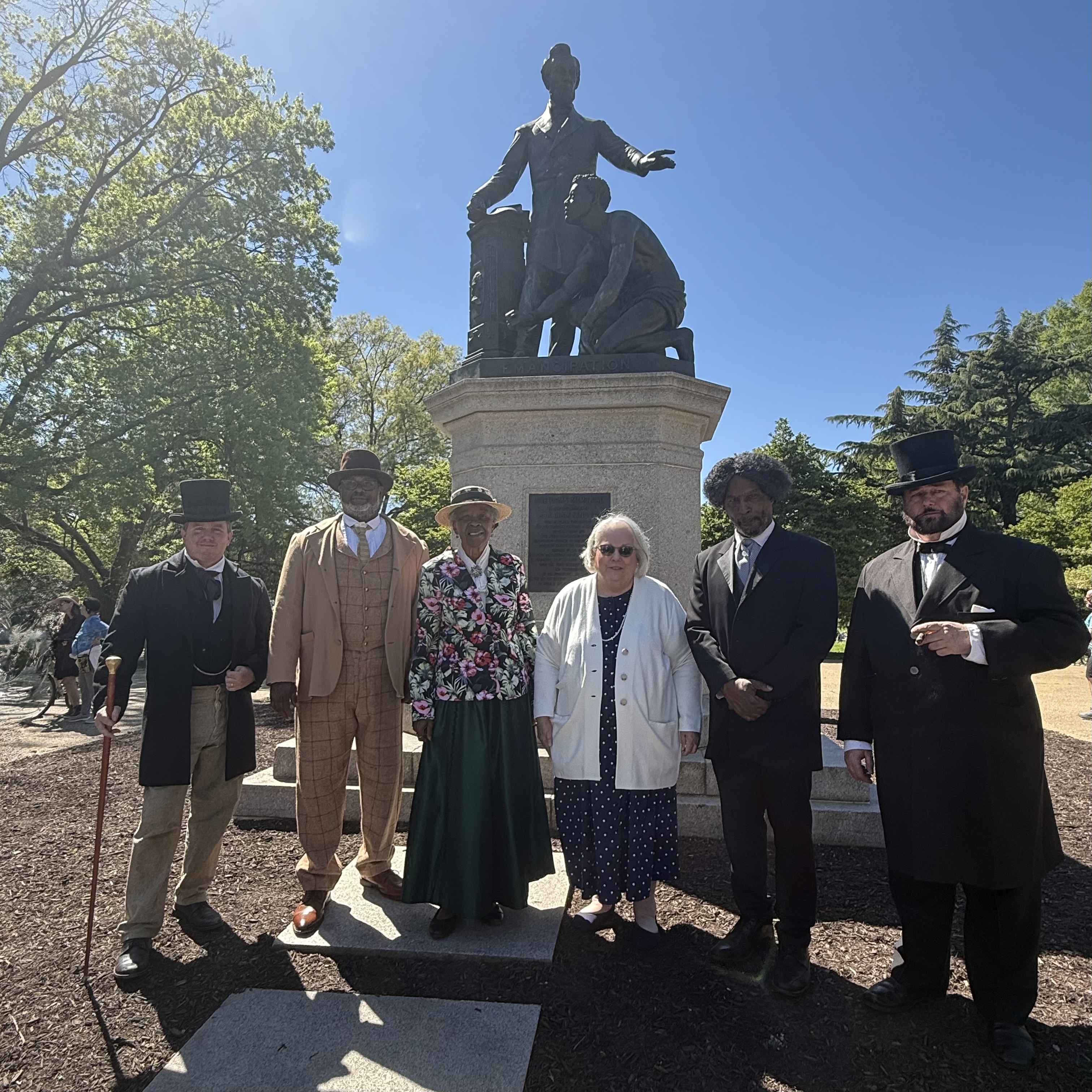
The Emancipation Memorial was originally dedicated before a crowd of thousands, on the 11th Anniversary of Lincoln’s Assassination, April 14, 1876. On April 11, 2026 the National Park System held an event marking the 150th Anniversary of the Emancipation Memorial. From Noon until 2:00 pm, the National Humanities Council entertained families with children’s activities, and there were vendors and historians in the park. (Above photo by Gerald Rinaldi)
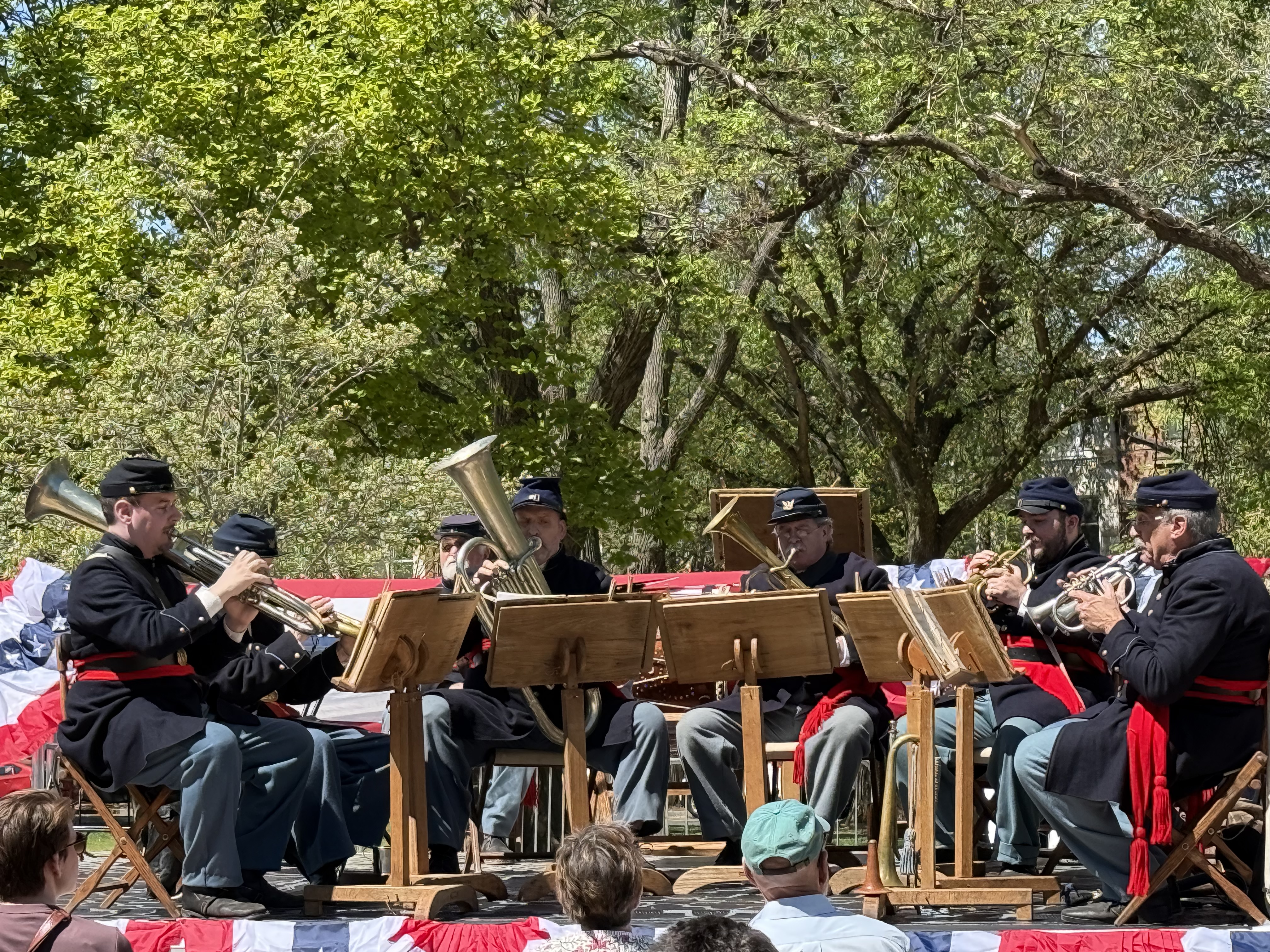
At 2:00 pm Kevin Bryant, Park Ranger began with an Introduction, followed by the Federal City Brass Band playing “Hail Columbia” [Eb Cornets- Brian Kanner & Steve Weise, Bb Cornet – Paul Cassarly, Alto Horn – Jeff Rogers, Tenor Horn – Chris Troiano, Baritone Horn – Dana Schopperet, Eb Brass Horn – Jim Ludlam and Rope Tension Drums – Garman L. Bowers Jr & John St. Peter].
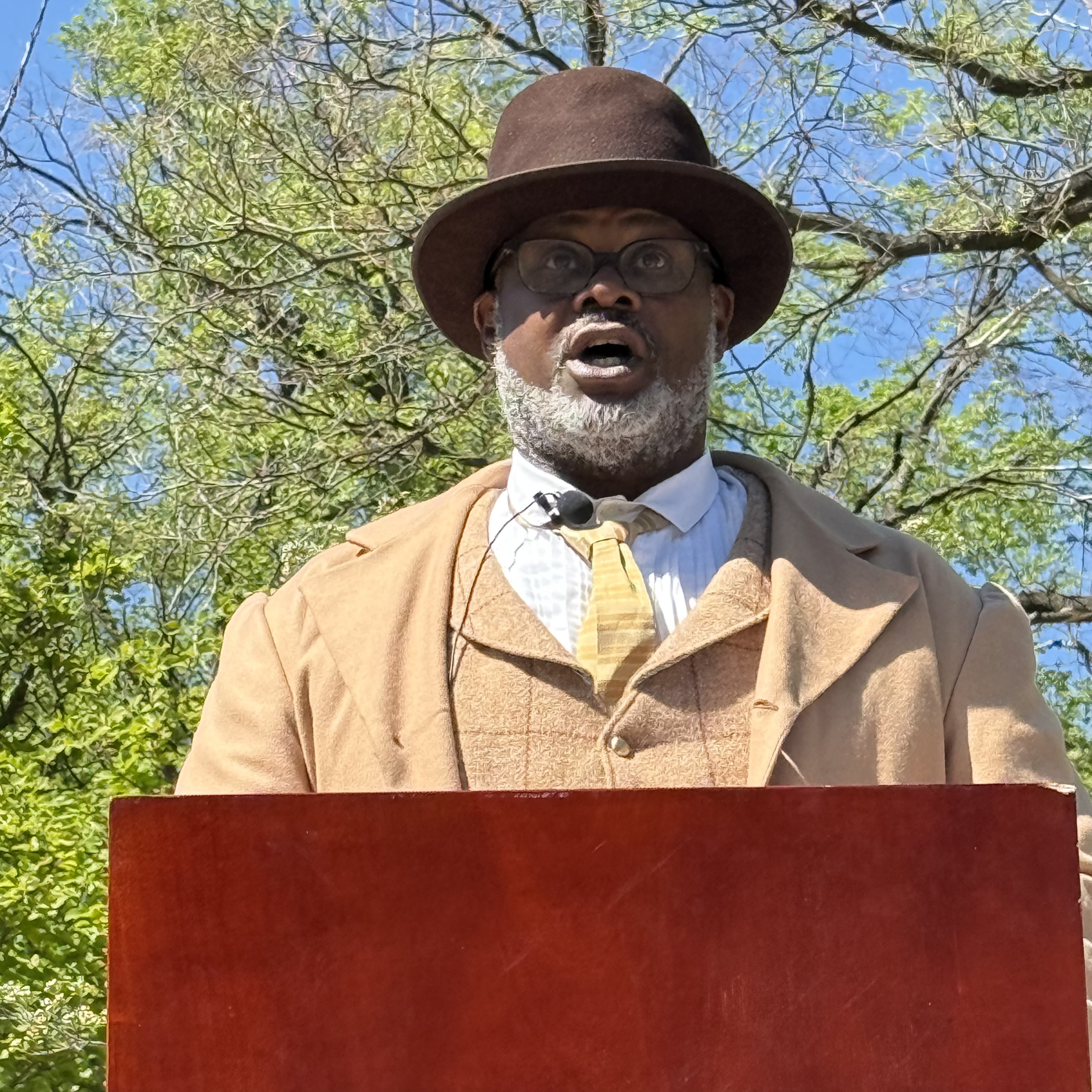
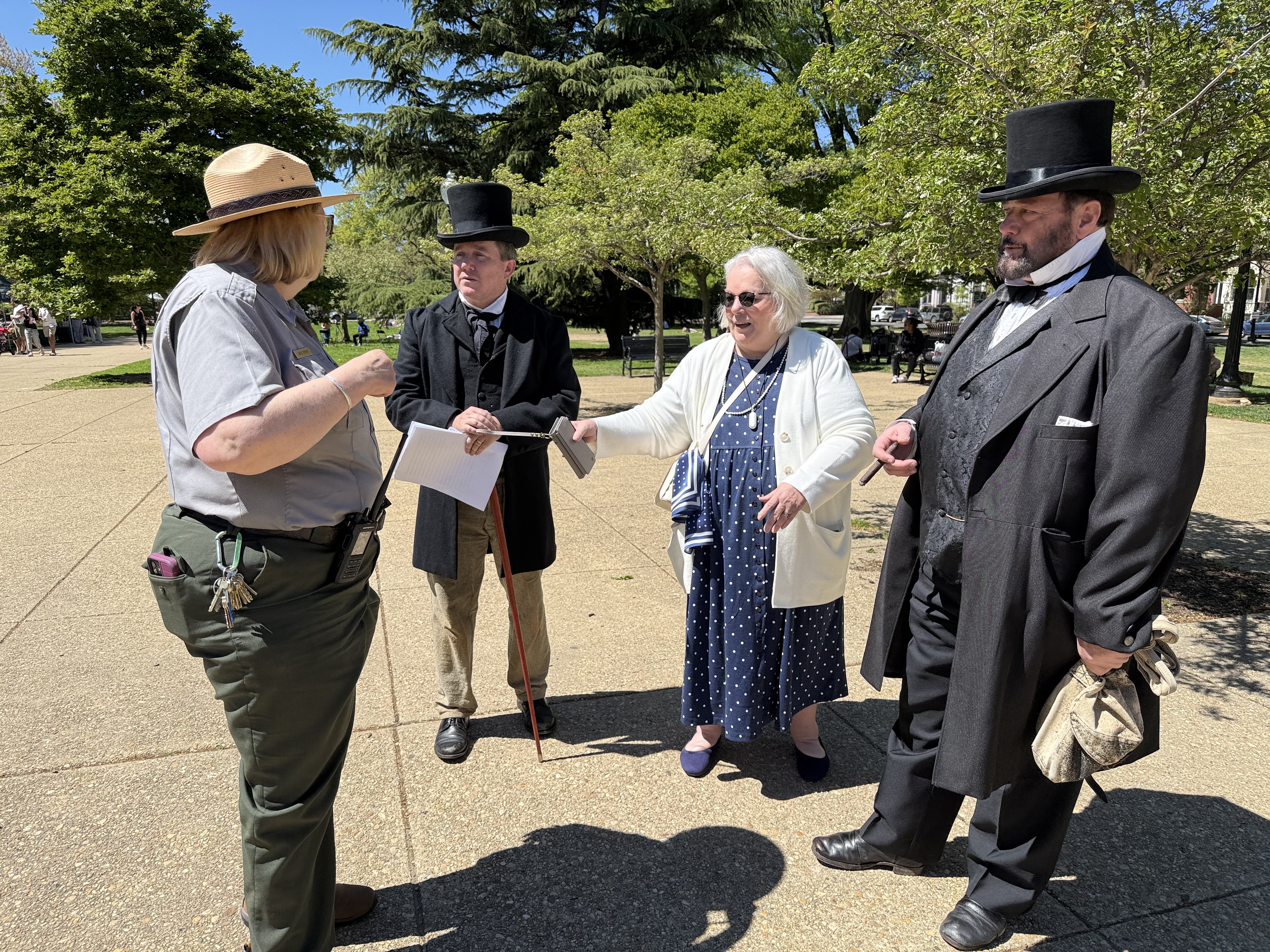
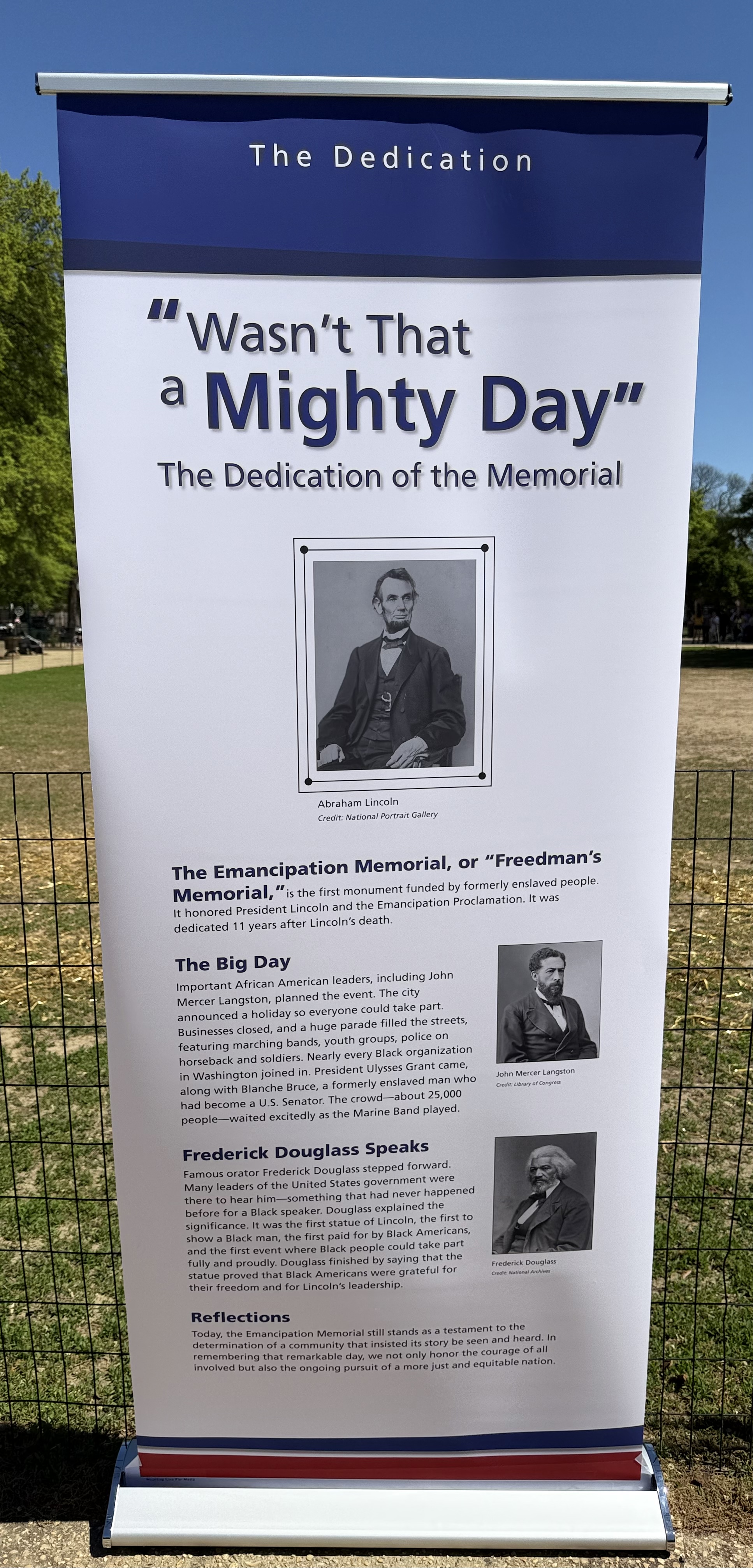
After an introduction by National Park Service’s Park Ranger, Kevin Bryant, came the opening by John Mercer Langston , [1829-1897] [Portrayed by Lambert Butler] An African American Abolitionist, and the great-uncle of Langston Hughes.] Langston was the President of the National Committee on Arrangements, which had begun years before, as Master of Ceremonies, and had worked with the Western Sanitary Commission on the arrangements for the ceremony. (photo by Gerald Rinaldi)
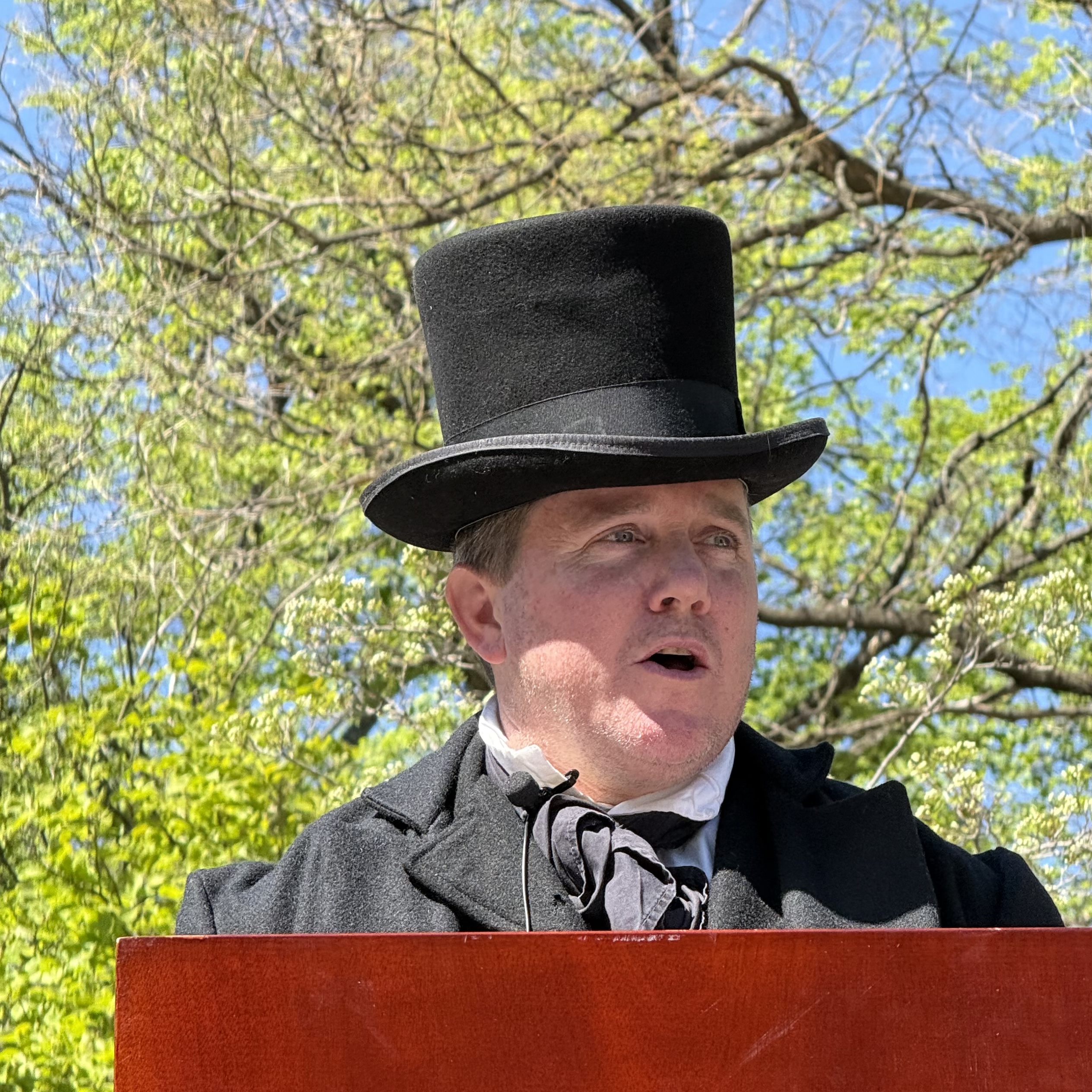
Langston then introduced James E. Yeatman, President of the Western Sanitary Commission.[ 1818-1901] [Portrayed by Mark Maloy] an abolitionist and philanthropist who led the WSC, under the tutelage of President Lincoln. The WSC worked closely with the Union Army and Navy, and was first responsible for building hospitals and staffing them with doctors and nurses, and then would later work with contraband camps, refugees, fugitives, and the U.S. Colored Troops. (Photo by Gerald Rinaldi)
“The Rev. Wm. G. Eliot, of St. Louis, to whom had been assigned the presentation of the monument for the acceptance and approval of those who had contributed the funds for its erection, and to give a short historical account of the same, has been prevented from doing so, and it has only been within the last few hours that I received notice that he could not be present, and that I was requested to take his place, which I am but poorly qualified to do. Asking your kind and considerate indulgence, I shall proceed to do so, as the representative and president of the Western Sanitary Commission, to whom was entrusted the contributions of freedmen and the expenditure of the same for the erection of the freedmen’s memorial at the national capital. It is perhaps proper that I should tell you how it was that the [Western] sanitary commission came to be intrusted with this work. This commission, composed of Rev. Wm. G. Eliot, George Partridge. Carlos S. Greeley, Dr. J. B. Johnson and James B. Yeatman, well known Union citizens of St. Louis, were appointed by General John Fremont and afterwards ratified by Secretary Stanton. Their duties principally were to look after the sick, fit up and furnish hospitals, provide competent nurses, &c. But as the war progressed their duties were greatly enlarged. The care of the families and orphans of soldiers, Union refugees, the freedmen; in short, all the humanities growing out of the war came under their charge.For these purposes large sums of money, clothing, &c., were contributed andsent to them, and I can say honestly and judiciously expended. Their total receipts amounted to over four and a quarter million. The whole of which was the spontaneous gift of individuals in all parts of the country, from San Francisco to Maine, and without the aid of a single organized auxiliary association. And finally, after the war was closed; after the lamented, honored and loved Lincoln had been so brutally assassinated in this city, five dollars was sent to us — the contribution of Charlotte Scott, a poor slave woman, who, on hearing of the assassination of President Lincoln, went in great distress to her mistress — that had been, for she was then free and said to her: “The colored people have lost their best friend on earth . Mr. Lincoln was our best friend and I will give five dollars of my wages towards erecting a monument to his memory. This money; this five dollars; this grain of a mustard seed, contributed by Charlotte Scott in gratitude to her deliverer, was sent to us by her former master, Mr. Wm P. Rucker, through the hands of General T. C. H. Smith, then in command of the military post of St. Louis, having received it from Mr. Rucker, who was a Union refugee, from Virginia, having sought safety for himself and family in Marietta, Ohio, taking along with him Charlotte Scott, and perhaps others belonging to him. It was this five dollars that was the foundation of this beautiful and appropriate memorial which we now see before us… *
*INAUGURAL CEREMONIES OF THE FREEDMEN’S MEMORIAL MONUMENT TO ABRAHAM LINCOLN, William Greenleaf Eliot Personal Papers, University Archives, Department of Special Collections, Washington University Libraries
Yeatman continued:
The original group was in Italian marble, and differs in some respects from the bronze group now to be inaugurated. In the original the kneeling slave is represented as perfectly passive receiving the birth of freedom from the hand of the great liberator. But – the artist justly changed this, to bring the presentation nearer to true historical fact, by making the emancipated slave an instrument in his own deliverance. He is accordingly represented as exerting his own strength with strained muscles in breaking the chain which had bound him. A far greater degree of dignity and vigor, as well as of historical accuracy, is thus imparted. The original was also changed by introducing, instead of an ideal slave, the picture of a living man — the last slave ever taken up in Missouri under the fugitive slave law, and who was rescued from his captors (who had transcended their legal authority) under the orders of the Provost Marshal of St. Louis. His name is Archer Alexander, and his condition of servitude legally continued until the emancipation act became the Law of the land. A photographic picture was sent to Mr. Ball, who has given both the face and manly bearing of the negro. The ideal group is thus converted into the literal truth of history without losing anything of its artistic conception or effect. *
*INAUGURAL CEREMONIES OF THE FREEDMEN’S MEMORIAL MONUMENT TO ABRAHAM LINCOLN, William Greenleaf Eliot Personal Papers, University Archives, Department of Special Collections, Washington University Libraries. To read the full speech by Yeatman see https://archeralexander.blog/2026/04/13/the-inaugural-ceremonies-of-the-freedmens-memorial-to-abraham-lincoln/
Following Yeatman’s speech, Langston returned to the podium and requested President U.S. Grant [portrayed by Ken Serfass] to do the honor of unveiling the monument. As the United States flag descended to reveal the monument, the Federal City Brass Band played “Hail to the Chief”.
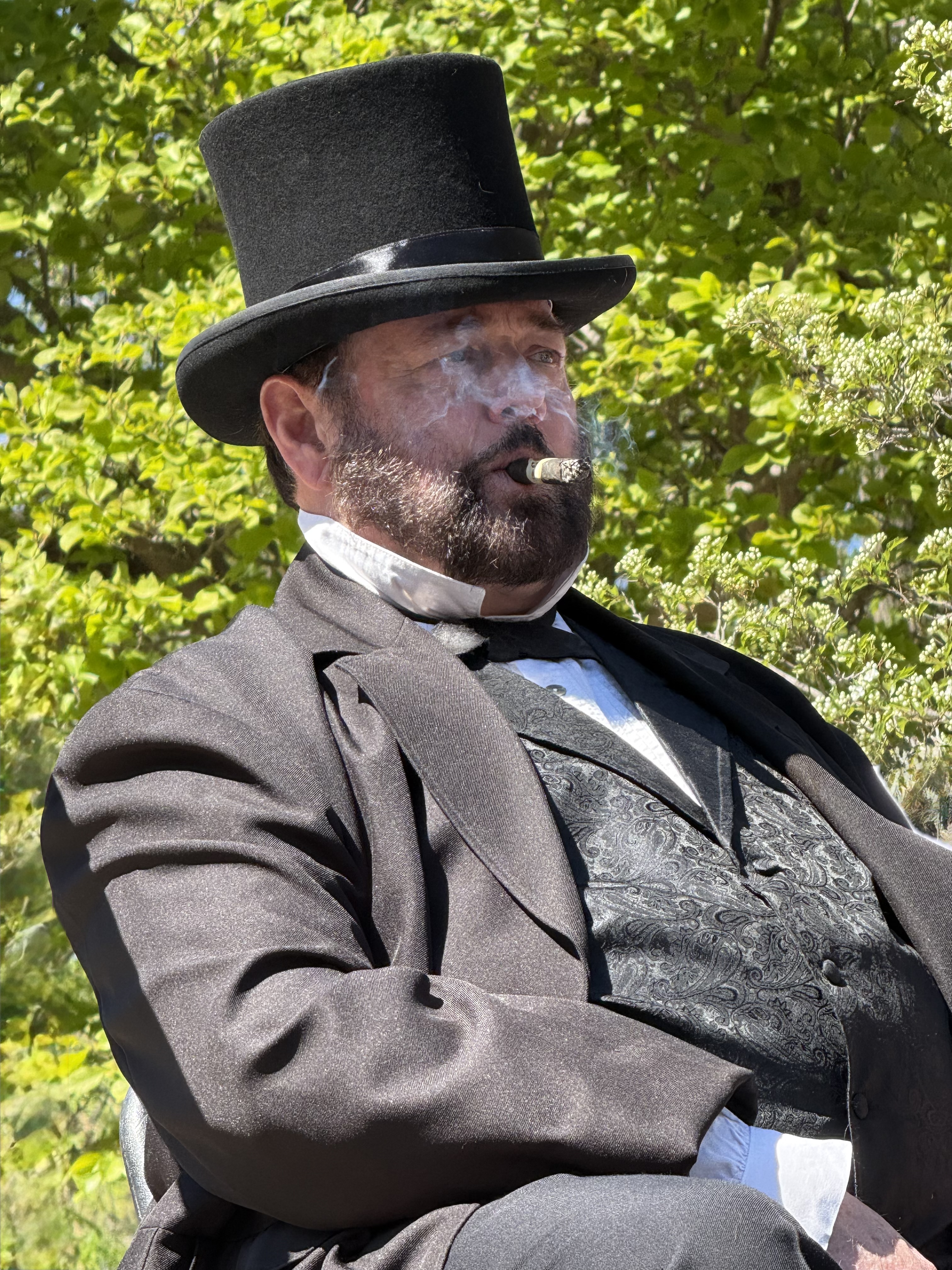
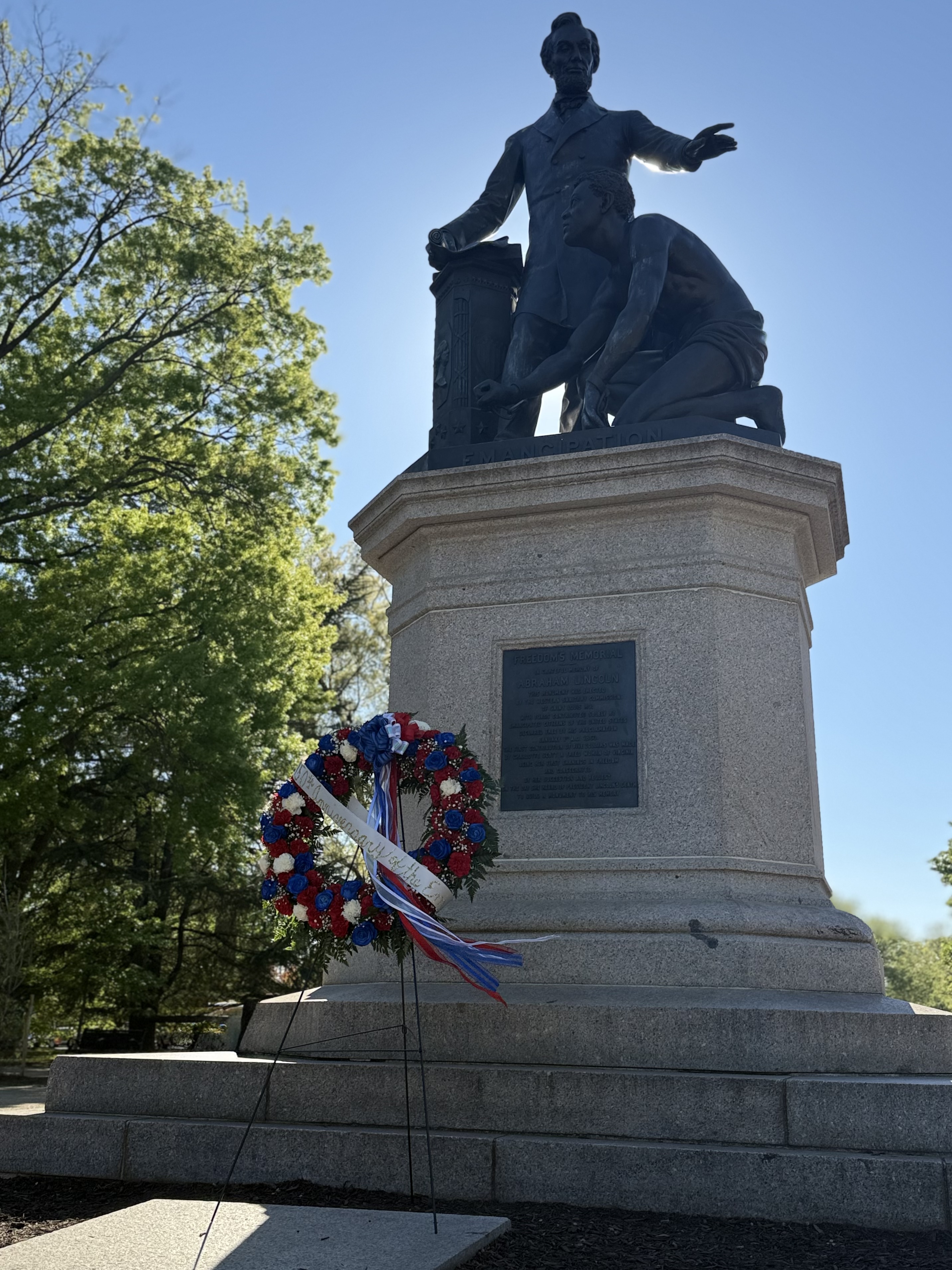
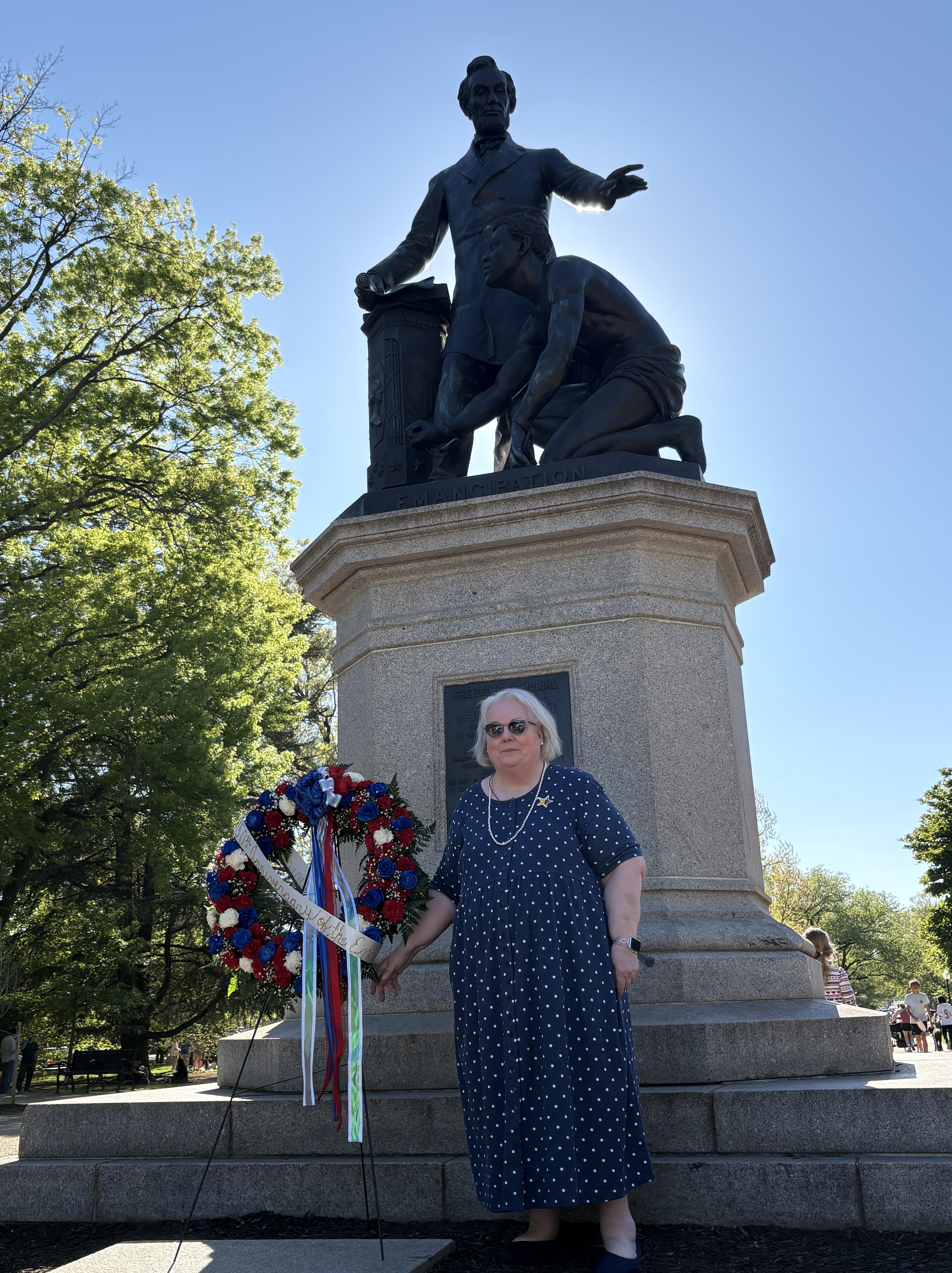
The monument stands on a granite pedestal ten feet in height, for which an appropriation was made by the last Congress. The martyred President is standing beside a monolith, upon which is a bust of Washington in bas relief. In his right hand, he holds the proclamation, while his left is stretched over a slave, upon whom his eyes are bent, who is just rising, and from whose limbs the shackles have just burst. The figure of the slave is that of a man worn by toil, with muscles hardened and rigid. He is represented as just rising from the earth, while his face is lighted with joy as he anticipates the full manhood of freedom. Upon the base of the monument is cut the word “Emancipation.” The figures are colossal, and the effect is grand. On the front, in bronze letters, the following inscription:
FREEDOM’S MEMORIAL
” In grateful memory of Abraham Lincoln, this monument was erected by the Western Sanitary Commission of St Louis, Mo., with funds contributed solely by emancipated citizens of the United States, declared free by his proclamation, January 1, A. D. 1863.”
” The first contribution of five dollars was made by Charlotte Scott,
a freed woman of Virginia, being her first earnings in freedom, and
consecrated by her suggestion and request, on the day she heard of
President Lincoln’s death, to build a monument to his memory.”
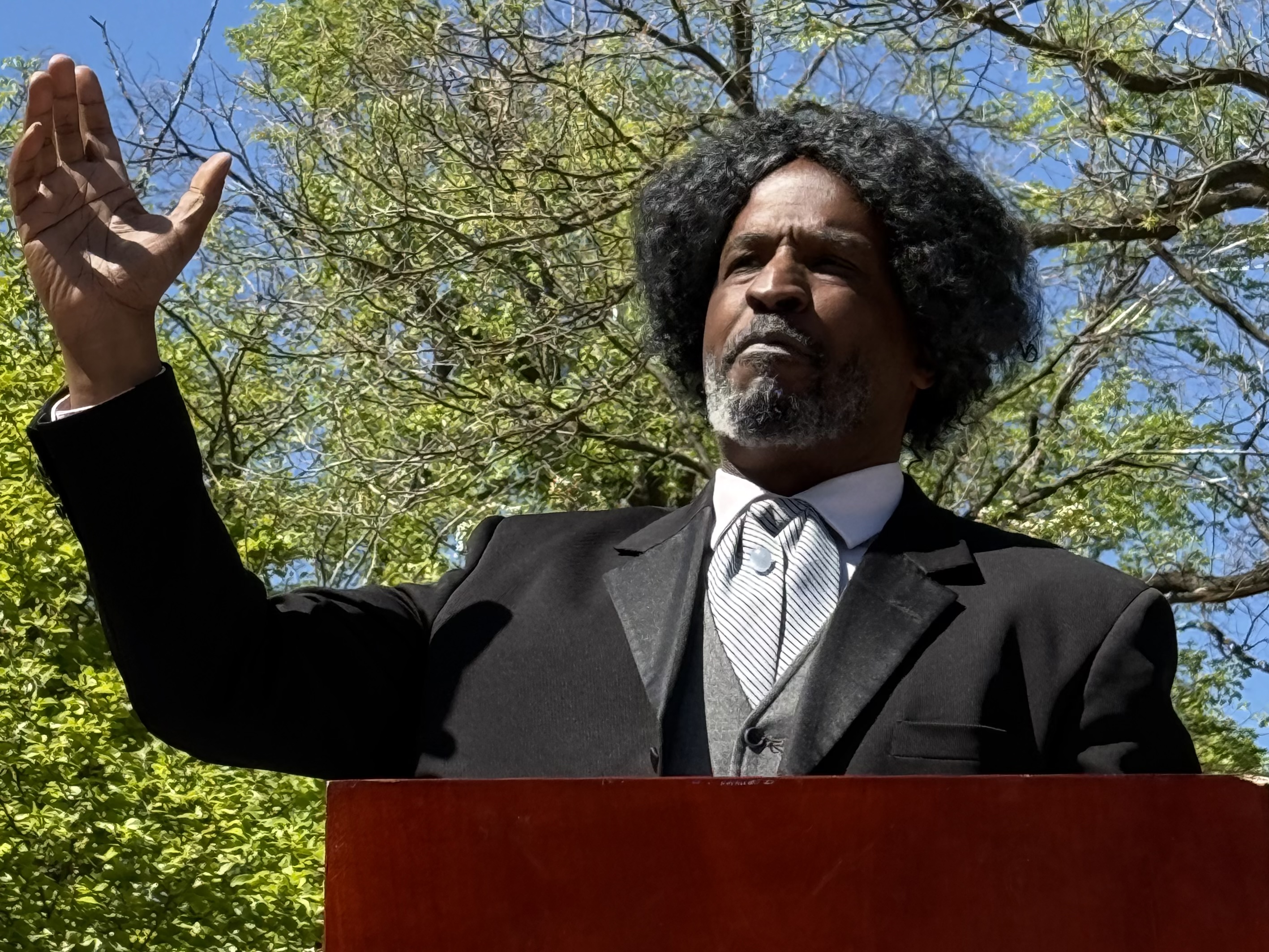
Then Langston introduced the Orator of the Occasion, The Honorable Frederic Douglass [portrayed by Darius Wallace]. Douglass began his lengthy speech with:
FRIENDS AND FELLOW CITIZENS: I warmly congratulate you upon the
Inaugural ceremonies of the Freedmen’s memorial monument to Abraham Lincoln [microform]. Washington City, April 14, 1876 by Douglass, Frederick, 1818-1895 Publication date 1876 Topics Lincoln, Abraham, 1809-1865, Lincoln Statue (Washington, D.C.), Statues
highly interesting object which has caused you to assemble in such num
bers and spirit as you have to-day. This occasion is in some respects
remarkable. Wise and thoughtful men of our race, who shall come after us,
and study the lessons of our history in the United States, who shall survey
the long and dreary space over which we have traveled, who shall count the
links in the great chain of events by which we have reached our present
position, will make a note of this occasion—they will think of it, and with a
sense of manly pride and complacency. I congratulate you also upon the
very favorable circumstances in which we meet to-day. They are high,
inspiring and uncommon. They lend grace, glory and significance to the
object for which we have met. Nowhere else in this great country, with its
uncounted towns and cities, uncounted wealth, and immeasurable territory
extending from sea to sea, could conditions be found more favorable to the
success of this occasion than here. We stand to-day at the national centre to
perform something like a national act, an act which is to go into history, and
we are here where every pulsation of the national heart can be heard, felt
and reciprocated.
Publisher
Saint Louis, Levison & Blythe, Printers.
This was followed by the Federal City Brass Band closing with “Sicilian Vespers”
PANEL DISCUSSION
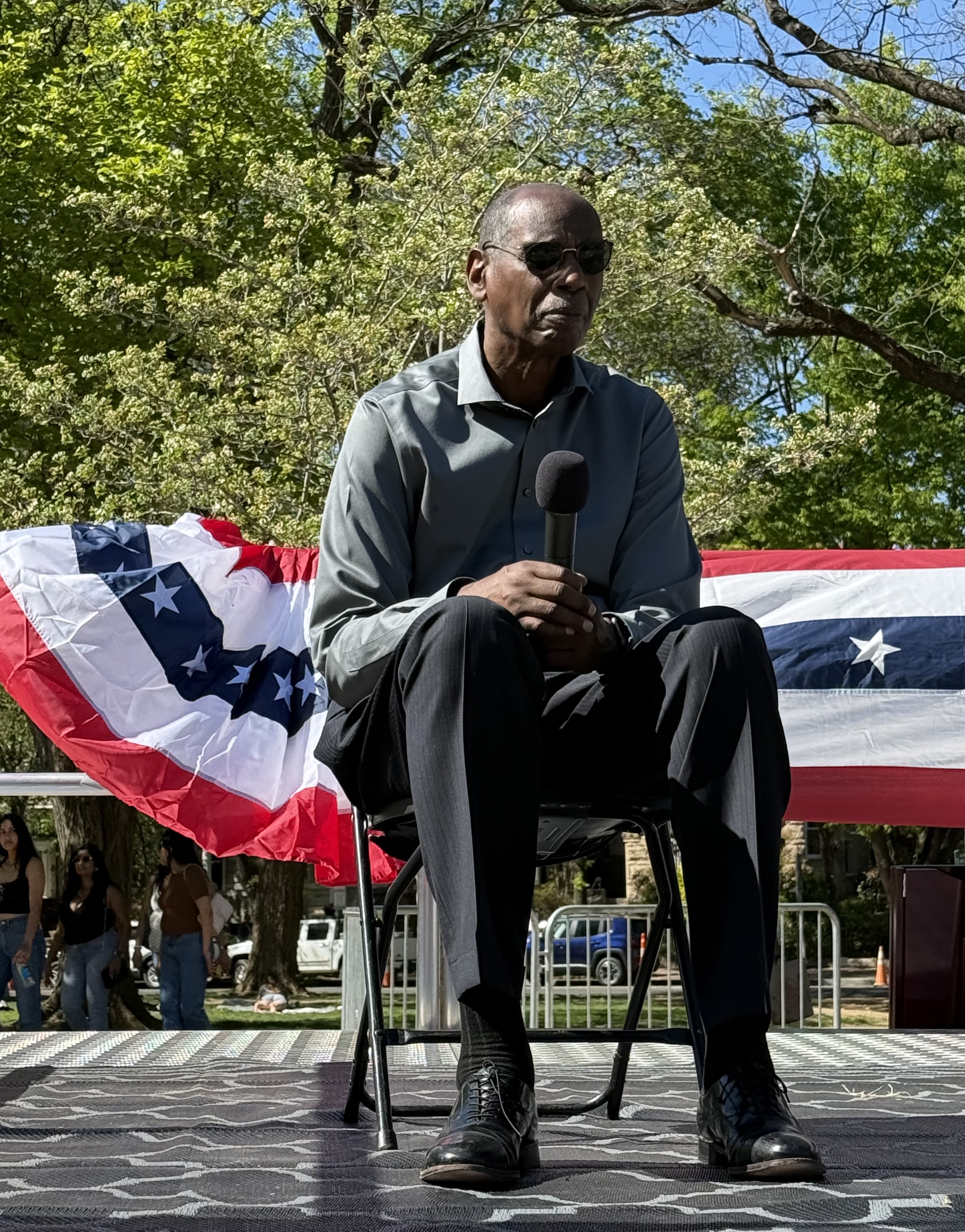
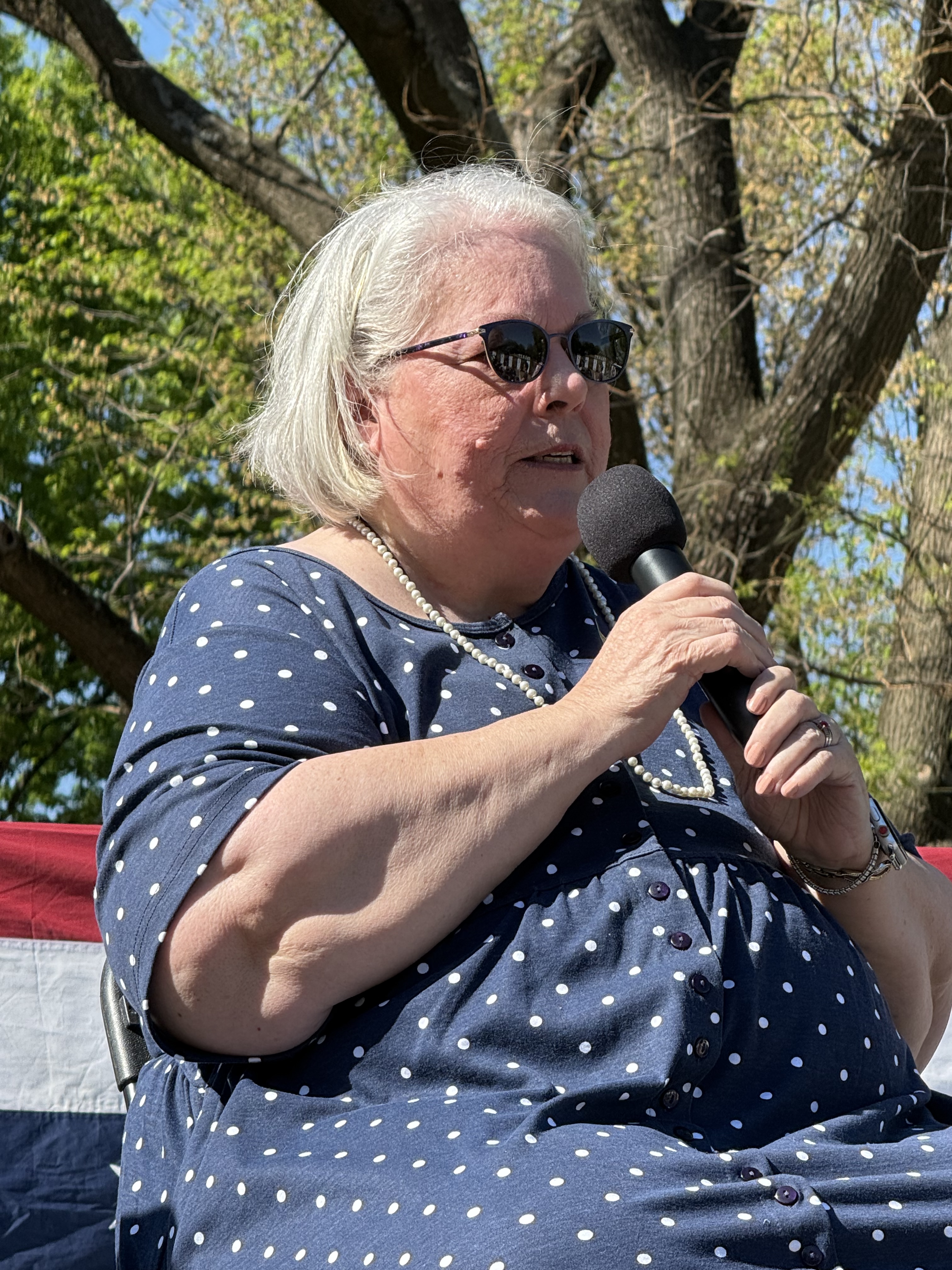
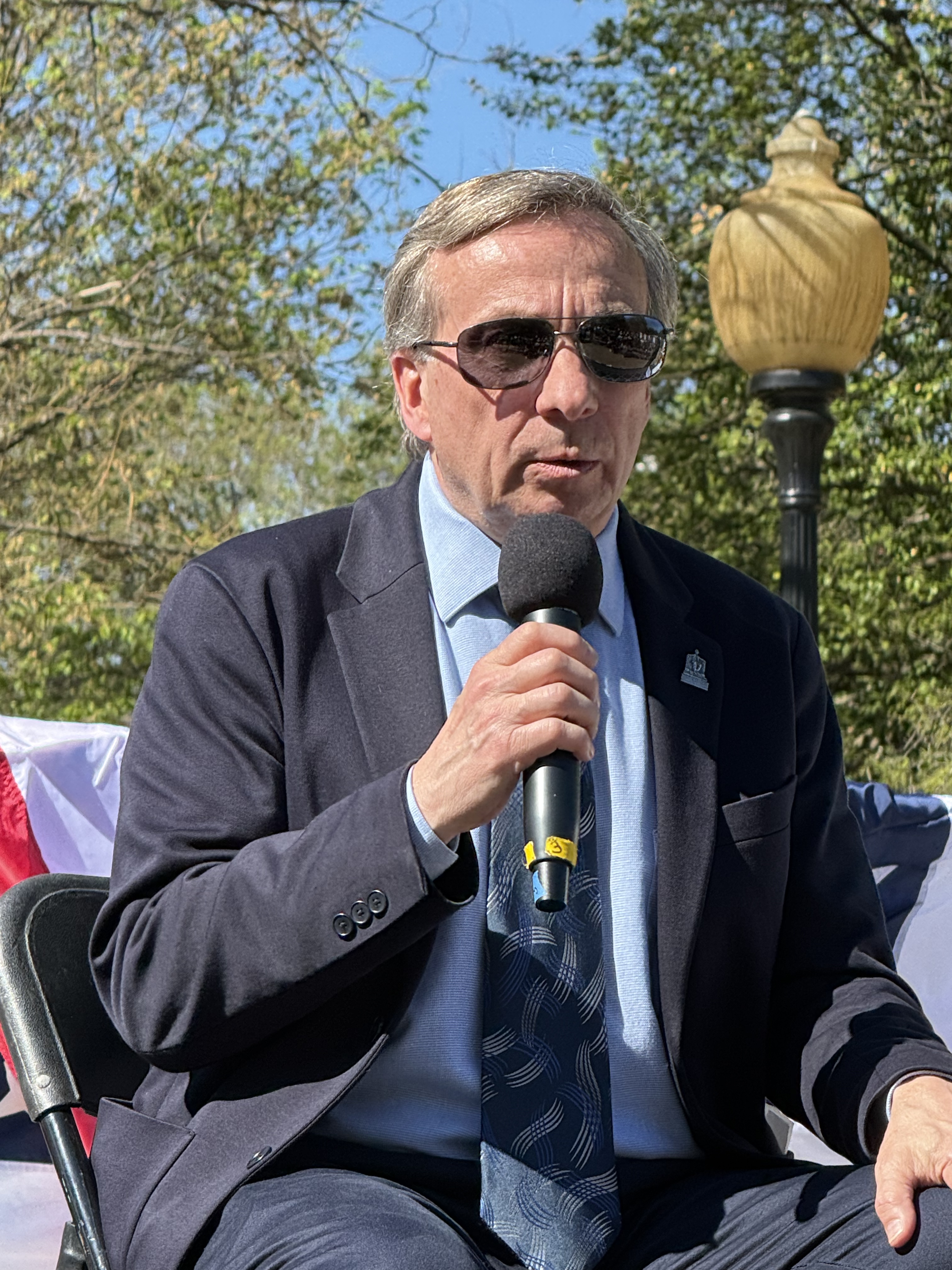
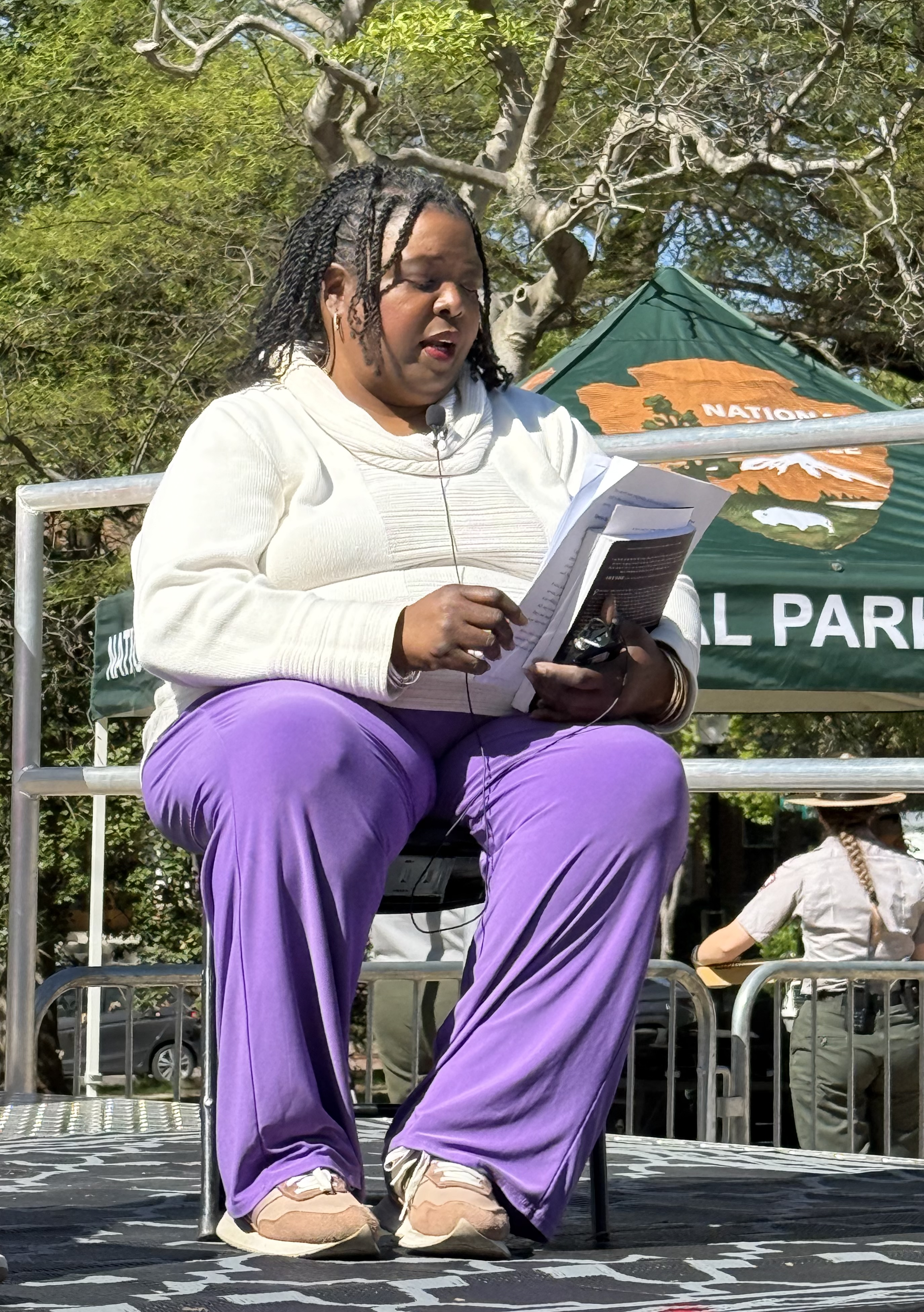
The Unveiling Ceremony was followed by a Panel discussion on the history of the memorial. The Discussion was moderated by Dr. Ida E. Jones, with panelists: Dorris Keeven-Franke, Historian and Author, David Kent, Historian and Author, Kenny Burns, Historian and DC tour guide. This was followed by questions from the audience.
LAYING OF THE WREATH
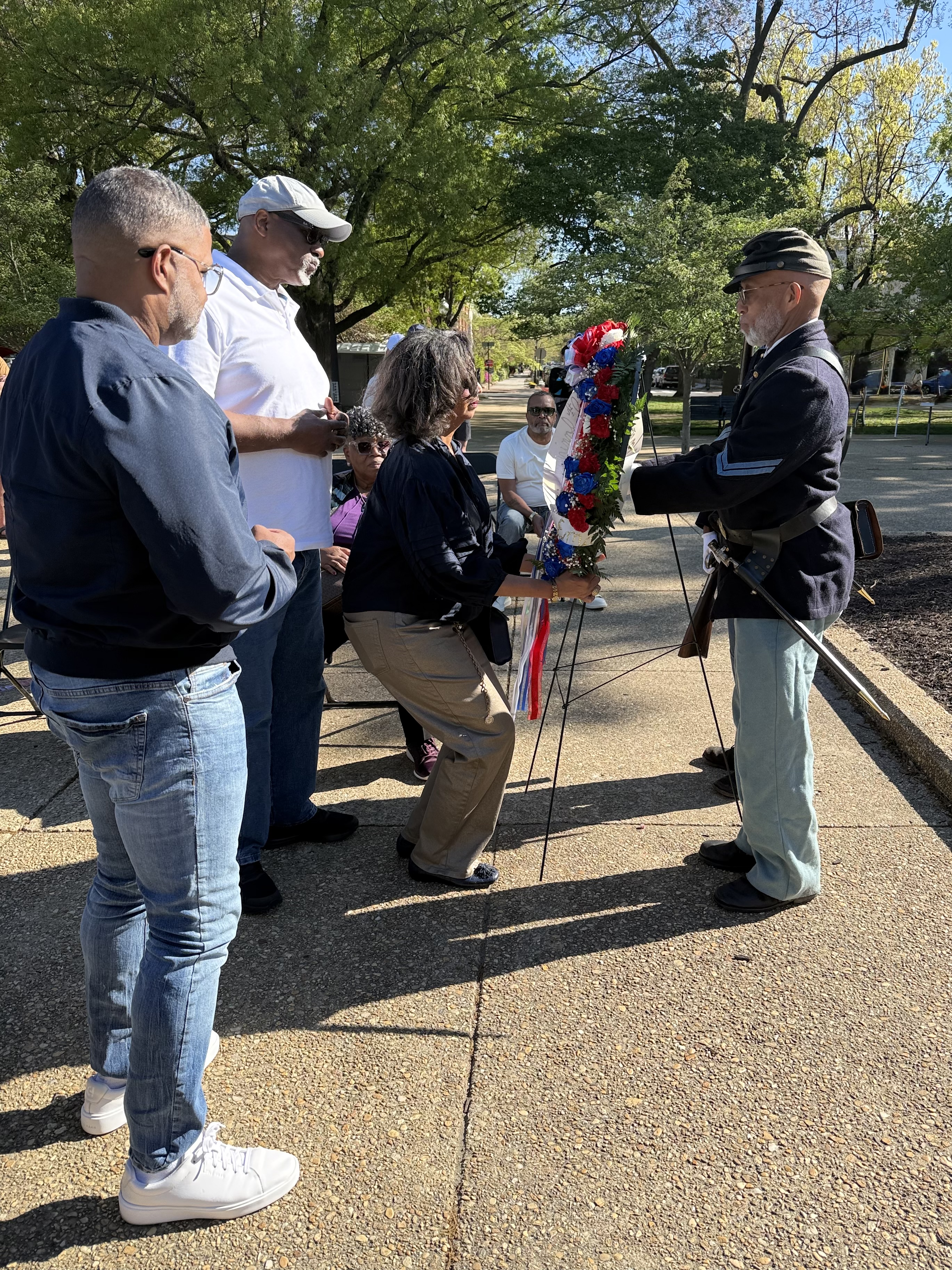
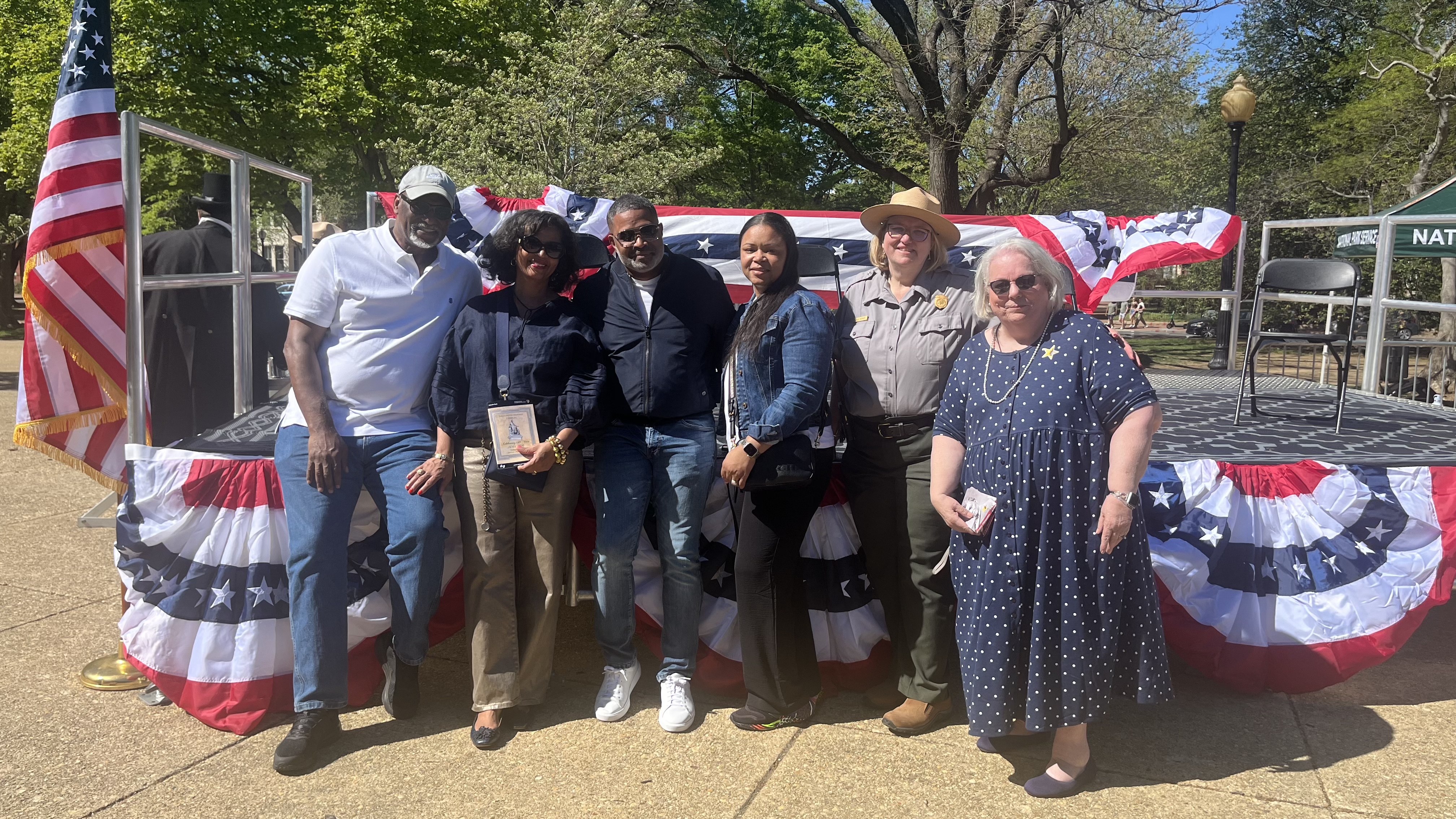
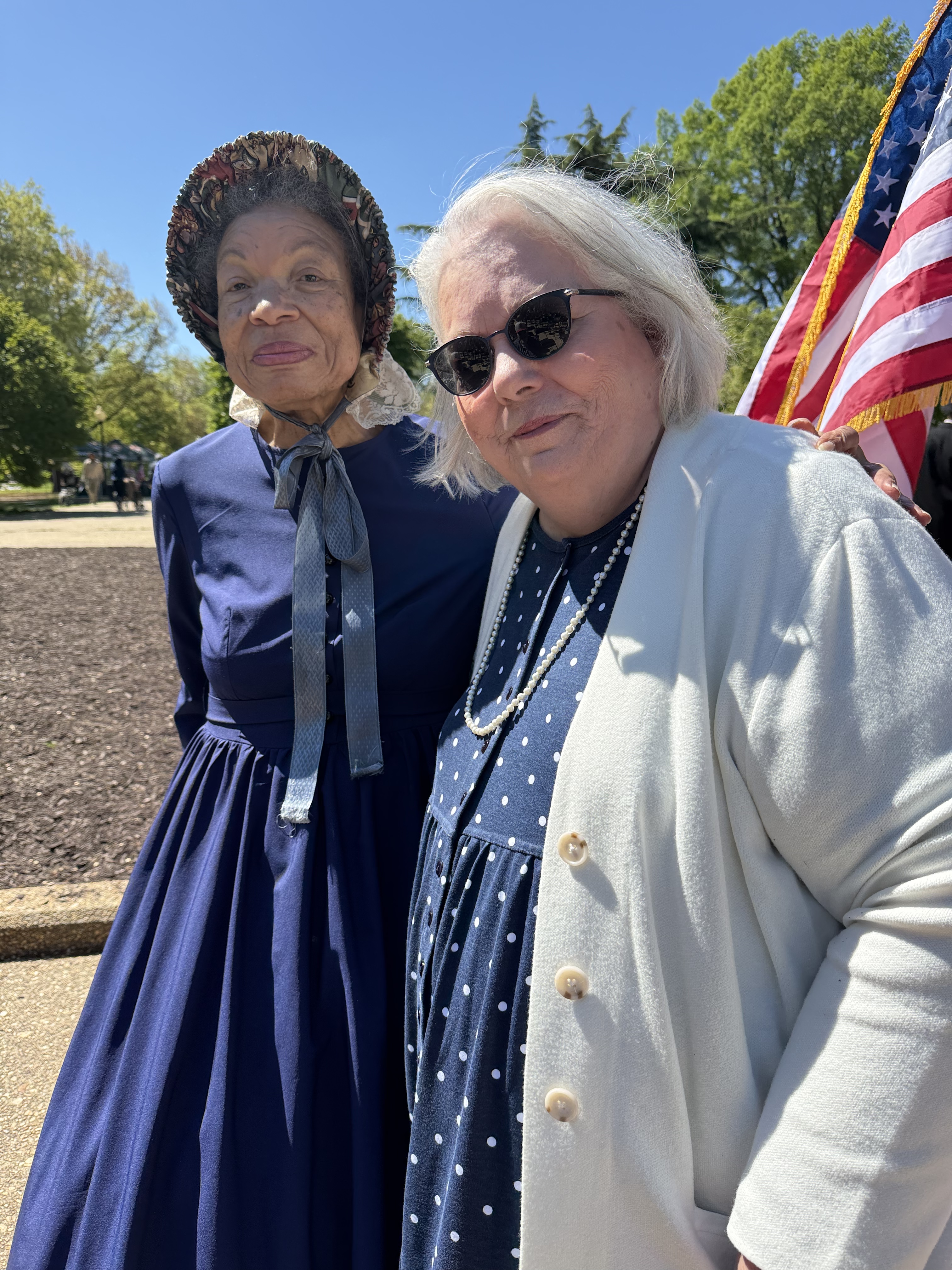
The afternoon concluded with reenactors of the U.S. Colored Troops presenting a beautiful wreath to descendants of Archer Alexander, Lyle and Leontyne (Clay) Peck [Wesley Alexander] and Donovan Cox [James Alexander].
SOURCES
- Inaugural ceremonies of the Freedmen’s memorial monument to Abraham Lincoln [microform]. Washington City, April 14, 1876by Douglass, Frederick, 1818-1895Publication date 1876 Topics Lincoln, Abraham, 1809-1865, Lincoln Statue (Washington, D.C.), Statues Publisher Saint Louis, Levison & Blythe, PrintersInaugural ceremonies of the Freedmen’s memorial monument to Abraham Lincoln [microform]. Washington City, April 14, 1876 by Douglass, Frederick, 1818-1895Publication date 1876 Topics Lincoln, Abraham, 1809-1865, Lincoln Statue (Washington, D.C.), Statues Publisher Saint Louis, Levison & Blythe, Printers
- *INAUGURAL CEREMONIES OF THE FREEDMEN’S MEMORIAL MONUMENT TO ABRAHAM LINCOLN, William Greenleaf Eliot Personal Papers, University Archives, Department of Special Collections, Washington University Libraries.
- https://archeralexander.blog/2026/04/13/the-inaugural-ceremonies-of-the-freedmens-memorial-to-abraham-lincoln/
Photos by Gerald Rinaldi


Leave a comment